


Tracking the River Ghost: The Goonch

Corbett's Legacy
The jungle's margins along the stony shoreline of the Ramganga came alive with the alarm calls of deer and monkeys. The balanced tranquility of the ecosystem had shattered - replaced by something far more unsettling: that creeping sense of being watched. Without the steady reassurance of the rifle in his hands, fear might have paralyzed him. Ahead, fresh pugmarks pressed into the moist earth and somewhere beyond them, a silent predator moved like a ghost through the underbrush. Jim Corbett was on the trail of a man-eater.

By the early 1900s, Corbett had already earned a legendary reputation, revered across the region for tracking and killing man-eating tigers and leopards. Much like the predators he stalked, Corbett worked alone, on foot, succeeding where entire hunting parties had failed. Born and forged by the Himalayan foothills, he possessed an instinctive command of the jungle, reading its signs, alarm calls, even silence itself like a language, and anticipating movement and tracking with uncanny precision.
More than a century later, I found myself walking those same forests along India’s Ramganga River… chasing a different kind of predator. Nestled along the borders of what is now a national park named after Corbett - who was instrumental in its creation - the roughly 200 square-mile sanctuary protects the same big cats he once famously hunted. In his later years, his life became dedicated to the preservation of these mystical creatures.

The park is defined and crossed by a series of rivers, among them the Ramganga. Today, I pride myself on drawing from similar instincts and tactics in a hunt of my own - though I was drawn to these hallowed grounds by a different kind of big 'cat': the legendary goonch catfish.
My pursuit of the world’s monster freshwater fish has always held this particular species in the highest regard. Widely considered among the most difficult fish on earth to catch, I knew its pursuit would push me further than I had ever been pushed - and plunge me into a region fraught with challenges.
A Plan Devised
I reached out to Jacob Chapa, who had partnered with me on my Congo expedition, and he was quick to accept. On missions like these, choosing the right partner is critical, and I knew Jacob had the mettle and mindset to endure long, grueling days with no guarantee of a single bite.
Operators in this region are few, but late last year I learned of a budding new operation built by an assembly of talented, experienced guides eager to make a name for themselves. Wild Water Creek - something of a “new kid on the block” - was looking to establish its reputation, but I recognized the team as a group of highly skilled anglers and trekkers from the area. The timing felt right to book the trip. I knew they would be eager to give their best, and I was equally driven to work hard and deliver them a showcase fish.
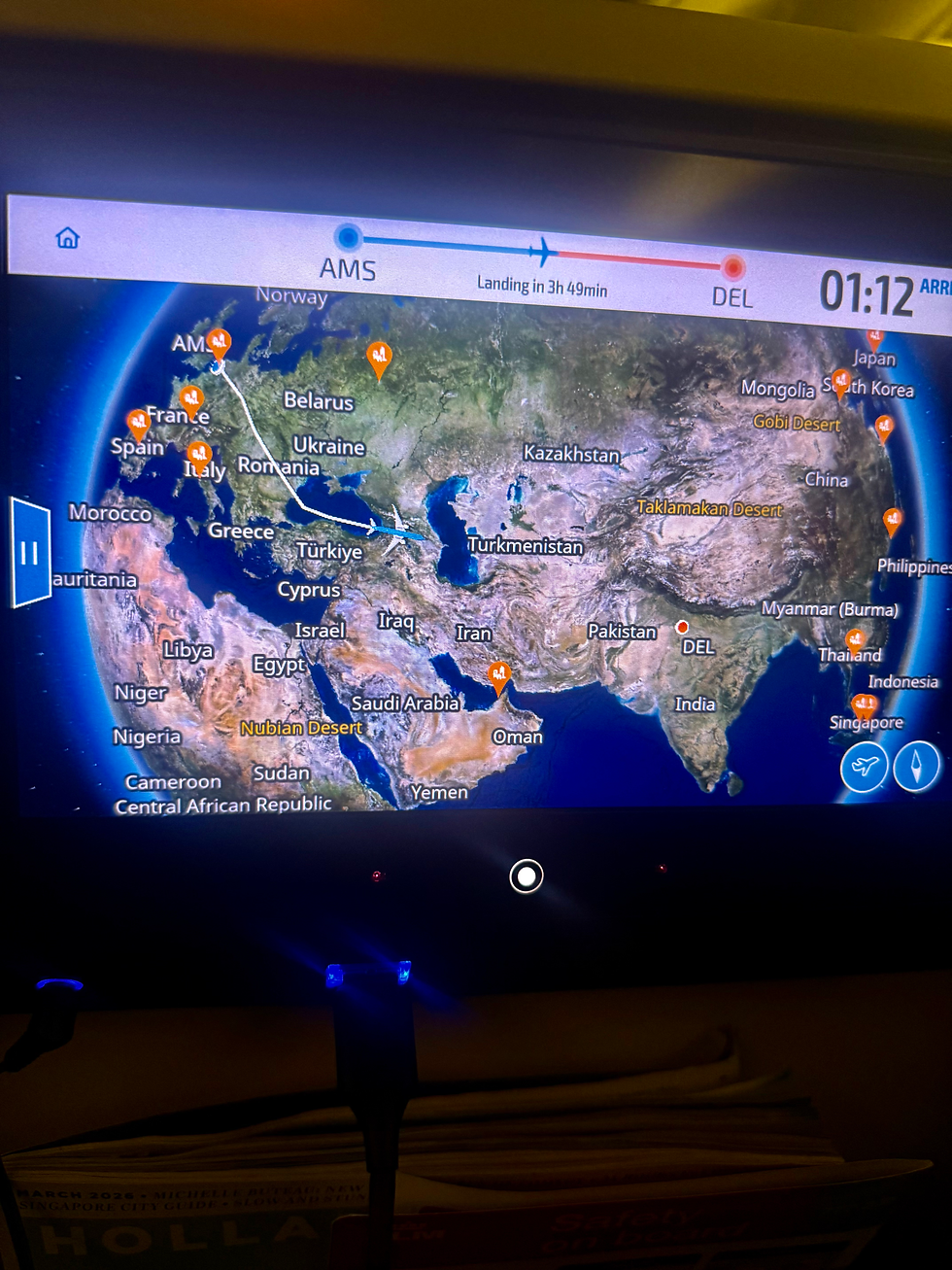
My route from Florida to India involved more than 32 hours of continuous travel - departing from home, connecting through Amsterdam, continuing on to Delhi, and then an eight-hour drive into the foothills of the Himalayas. Those long hours of travel were only preceded by nearly two years of dreaming and meticulous planning..

Camp Wild Water Creek
The main base camp at Wild Water Creek is an impressive riverfront compound of large-scale tents. Each is outfitted with two double beds, electricity, and a private restroom with a hot shower. The entrances face the river, giving each tent a direct view of the water. Adjacent to the tents is a covered dining area, centered around a long, family-style table. We were welcomed to camp with cold drinks and a hot meal. The staff made an immediate impression - they took tremendous pride in their work and carried themselves with purpose.


The plan was to target a series of isolated deep pools along the Ramganga River, beginning at the primary camp and moving south, downstream, through a network of mobile camps toward the boundaries of Jim Corbett National Park, where fishing is prohibited. Within the park lies a large reservoir fed by the Ramganga. The river itself is partially glacial, sustained by snowmelt and seasonal rains, and each year it experiences periods of high water. It’s believed that during these high-water events, large goonch catfish migrate throughout the system. As the river recedes, some remain - seemingly trapped in the isolated deep pools of the upper stretches.


Our plan was simple: map out deep pools - typically positioned at sharp bends beneath steep bluffs, often just below a series of riffles and light rapids. During low-water periods, the river here runs especially clear. The deeper pools reveal themselves in darker hues of blue, making it easy to identify likely holding water and assume goonch lie below.
I approached this trip knowing the fish would be hard to come by. The goonch is a notoriously infrequent feeder, seemingly sustaining itself on only occasional meals. These fish emerge from cavernous hiding places to take one substantial feed, then retreat again - sometimes for weeks. In cold, fast-flowing Himalayan systems, a truly giant goonch may be decades old.
Understanding how rarely they feed meant preparing our mindset and balancing patience with outright stubbornness. We committed to no more than three days per pool, giving us roughly three to four locations to focus on over our ten full days of fishing. That meant choosing each pool carefully and accepting the long, inactive hours that would come with it.
Bait and Wait
This style of fishing has been the subject of some narrow-minded debate, the idea that placing a live or dead bait on the bottom is somehow “easy.” And in certain cases, that may be true. But taken in totality, passive bait fishing is anything but simple. The years of planning, the research, the money invested, the gear preparation - these are all attempts at control. As anglers, we crave control. We gravitate toward the things we can influence, even as the one thing we value most - the fish - remains beyond it.

With lure fishing, we exert even more control. We choose what to throw, adjust the presentation, change the retrieve, reposition cast after cast. Each deliberate change carries renewed hope. Every cast re-energizes the angler and demands attentiveness.
Bait fishing is different. It requires you to relinquish that control almost entirely to the fish. You’re left to wait - alert, but often under the heavy weight of uncertainty and long stretches of inactivity. And in an environment overflowing with beauty and wildlife, those surroundings become a quiet distraction. There’s a dilemma in surrendering the chance to fully take in the magic around you and knowing that a single lapse in focus could cost you the fish you’ve traveled so far to find.
Because every waking hour needed to be spent tending lines, we rarely pulled the baits. It meant fishing around the clock. Jacob and I worked in loose shifts drifting in and out of sleep while the other managed the rods. We knew the bites would likely come at odd hours.

At most sites, camp was set comfortably in shaded sand, with tents and inflatable mattresses. The water was low, leaving the immediate shoreline a jagged minefield of uneven stone unfit for camping. If we wanted the comfort of a tent, it meant sleeping uncomfortably far from the rods.
I wasn’t willing to gamble on hearing a bite alarm from that distance - waking from deep sleep, fumbling with a tent zipper, then scrambling fifty yards over uneven rock. If I was going to sleep at all, it had to be right beside the rods.
In the first several days of fishing, we had absolutely zero activity. We passed the hours watching nearby wildlife. I kept myself entertained with a motion-activated trail camera I had brought along, placing it strategically along natural game trails where I found prints and other signs. Each morning, retrieving the footage became a welcome break from the monotony, something to look forward to. Over the course of two weeks, I captured images of wild boar, deer, peacocks, and even an Indian leopard cat. I held out hope for a glimpse of a larger predator, but none ever passed in front of my cameras.
A Dangerous Reminder
On the third day, we were given a stark reminder of the very real dangers around us. Word came in that a leopard had attacked several people along a nearby river system during a riverside funeral service. In India, the dead are often honored through cremation, with ashes placed into the river. During one such ceremony, a leopard attacked participants in broad daylight. It then fled into a nearby camp, entered a large tent structure, and remained there for several hours before ambushing a man who had gone into a restroom. He was hospitalized from the encounter. Such a brazen attack is hard to fathom... but it lingered in the mind, especially when we found ourselves isolated on the riverbank at night with virtually no protection.
Those thoughts had a way of shaping the darkness. Every unknown silhouette seemed to take the form of a tiger or leopard, half-illuminated by moonlight. One night, as I slept exposed on a cot beneath the stars, Jacob nudged me awake and whispered that a tiger was watching us. I turned in the direction he pointed and saw it - a massive shape, silhouetted against the faint glow of the river, moving slowly in our direction. I reached for the Streamlight beneath me and cast a beam toward it. Two eyes reflected back, suspended nearly six feet off the ground - huge animal!
To my relief it was only a large male sambar deer. Similar to a small elk, this nocturnal species is native to the region and a primary prey animal for tigers. Its size and antlers were imposing enough, but it turned and disappeared into the brush.
First Contact
In the early hours of the fourth day, just before sunup, I was on “rod duty” while Jacob slept more comfortably in a tent. I drifted in that strange space between sleep and awareness when one of the rods set up on an electronic bite alarm suddenly screamed to life. The fish had taken with such authority that the butt of the rod lifted off the ground, threatening to be dragged into the river if not for the baitrunner being set just loose enough.
I came tight to the fish. It pulled hard, but the sharp head shakes and erratic changes in direction told me this wasn’t the giant we were after. Still, it was a welcome breakthrough. It wasn’t trying to burn off long runs; it was digging, searching for structure, trying to wedge itself into a hole. I knew then, this was a goonch.

The fish came to shore somewhere around 25 pounds - a baby. But it was my first encounter with the species. More than anything, it was proof. A small step, maybe, but enough to show that our approach could work - and that with patience and commitment, something special might still be waiting for us before the trip’s end.

Pushing Deeper to the Edge
We moved camps at different stages of the trip, pushing progressively deeper into more remote terrain. At times, we followed unmapped dirt and stone roads carved into the mountainside, where our tires skirted the cliffs edge by razor margins. The ride was not for the faint of heart. At one point, the vehicle stalled and began to roll backward while attempting to climb over a section where a landslide had clearly torn through the road. The tires - already worn nearly bald - spun in place as I looked out the window at a sheer drop to certain death.
In moments like these, when real challenge presents itself, I find myself caught between panic and a steadier, hard-earned understanding drawn from past experience... that if we just push through, if we can get past the obstacle in front of us, something special often lies on the other side.
By day six, we decided to gamble - pushing even farther through rough terrain to reach a pool we had marked months earlier. We were already set up on a promising stretch, but this pool lay about two miles downstream, accessible only if we were willing to hike, climb, and wade our way to it. We talked it over the night before, and I pressed Jacob on its potential. In my experience, when opportunities like this present themselves - when you have the choice to push deeper, to risk failure after hard effort - those are often the moments that produce the biggest fish.
I was reminded of a trip to Suriname a few years earlier, when my brother and I convinced our indigenous guides to load extra fuel so we could push deep into a remote tributary. We fought our way through dense jungle to a confluence we believed in, and after nearly a week without success, it was there that we landed a massive piraiba catfish.
Moving On Instinct
We devised a plan... I would use an inflatable packraft to run downstream through light rapids, carrying bait and a small selection of gear. Two of our guides would hike through the jungle, navigating cliffs that forced them to make two separate river crossings. Jacob and another guide would take the rough roads down to a nearby temple, then hike in from there, crossing the river once before hiking upstream to the pool. The plan split our team into separate routes, all converging on the same destination.

I made it through the first section of rapids, but the second got the better of me. The raft pinned against a large boulder, twisted sideways, and flooded as the current washed over it. I managed to limp the raft to shore and continued the rest of the way on foot, carrying both the gear and the boat over my shoulder. There was no real ground to walk on, just hopping from one boulder to the next.
Along the way, I spotted a fresh set of pugmarks pressed into the damp sand by the water - a leopard. I was reminded of the treks made by Jim Corbett over a century ago - on foot - along the river's edge, hunting the 'Baagh' (tiger)... an intriguing linguistic overlap with the Baghair (goonch). The fish carries no literal tie to the tiger, yet in these rivers, it fills the same role: a shadowy apex predator, every bit as elusive and revered... and like Corbett, I was on it's trail.

There was no real opportunity to pitch a tent where we set up.. the entire exposed riverbed was made up of massive boulders. Instead, I found a small patch of sand that had collected at the base of a particularly large rock. We leveled it out, cleared away a few stones, and made a bed right there on the ground.

Something about the place felt right. Just below a stretch of rapids, the river made a sharp left turn. On the opposite bank - the outside bend - stood a steep, towering cliff. Beneath it was a deep pool. Where the bend tightened, the cliff face recessed slightly, creating a swirling, cauldron-like effect in the current. Factoring in the effort it took to reach the spot, the uncomfortable night ahead, and the way the water moved through that bend, I had a strong sense that this was where something big would happen.
The Hardware
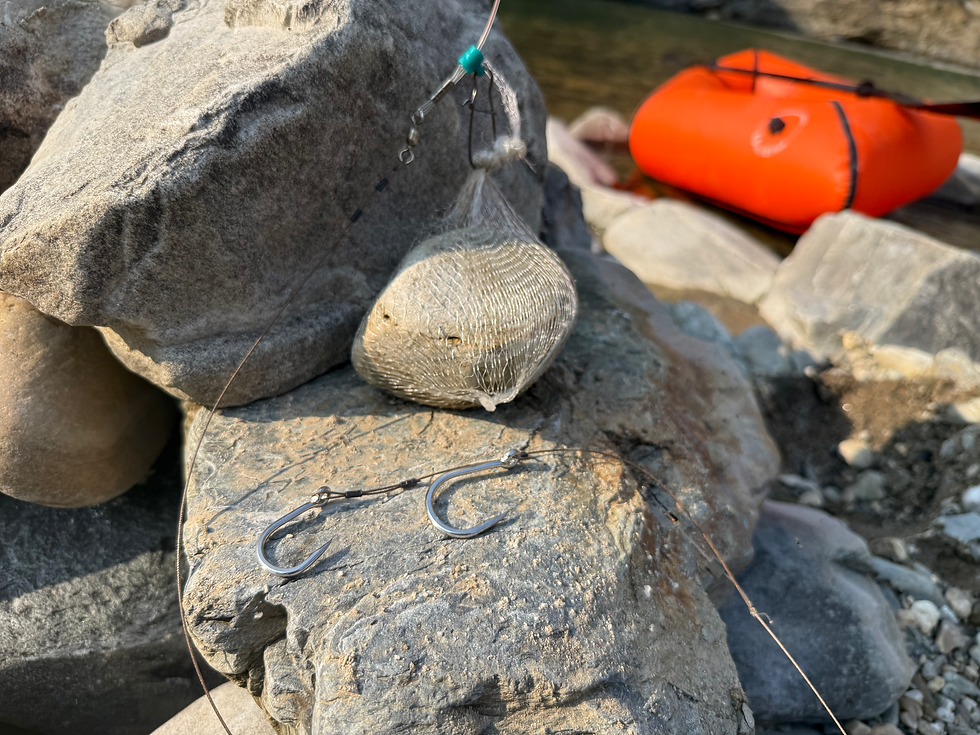
We had developed a rigging method that allowed us to contend with the power of the current in these conditions. Our guide, Sanjeev, would paddle across the river with the packraft carrying small wooden pegs. He would wedge a peg into cracks in the rock face on the opposite bank, tying off a length of cotton thread with a snap swivel attached. He would then clip our main line to the swivel and lower the leader into the target zone below. With steady tension from the rod, the main line would remain elevated above the current, pivot at the peg, and drop straight down into position - eliminating the drag of the moving water on our line. The peg itself was set just firmly enough to hold, but designed to pull free under the pressure of a strong fish.

To further handle the conditions, we ran 100-pound braid as our main line, connected with an FG knot to a 20–25 foot section of 200-pound monofilament shock leader. The heavy mono served to withstand abrasion as the fish dug into the rocks. I opted for longer shock leaders than usual, knowing we’d be deploying baits by packraft rather than casting.
The mono was then connected to a 4–5 foot section of 100-pound 7x7 steel leader, with two 7/0 to 11/0 3x baitholder hooks crimped directly to the leader. On the shock leader, I added a sinker slider clip - but instead of lead weights, we used rocks. Each rock was secured in a light monofilament mesh produce sack and clipped to the rig. If the weight rock lodged, the mesh would break under pressure, allowing the rock to fall away freeing the line.
A Monster at Daybreak
Jacob and I slept essentially on the ground that night. Alternating between the two of us, we monitored the rods through long stretches of inactivity. As had been the case with the smaller goonch I’d caught earlier in the trip, the bite came just as the sun began to rise. I was fully asleep when I woke to the sound of bells rattling on one of the rods. We had clipped bells to each rod tip, paired with small battery-powered glow lights. I awoke just in time to watch Jacob grab the rod and come tight to a monster.
His fish took with authority, ripping drag and driving straight for the rocks. Within moments, it had done exactly what we feared, wedging itself deep into an underwater snag. It could have been over right there if not for the packraft. Sanjeev jumped in and paddled out above the fish, pulling on the line from a higher angle until the fish came free. From there, Jacob was back in control.

Eventually, the fish came to shore, where I was able to grab it and wrestle it by the tail into the shallows - sealing the deal on an absolute dream fish. Jacob’s fish was an absolute trophy, and put him in a rare fraternity of anglers to have achieved such a catch. We stood there for a moment, marveling at the size, the character of it, what it had taken to make it happen - before capturing a series of photos and video.
We kept fishing, but now with a tremendous weight lifted from our shoulders. That one fish changed everything. It allowed us to fully appreciate the landscape and the wilderness around us. Fishing in a place like this is brutally difficult.. if not for the beauty of the land and the abundance of wildlife, it might be unbearable.

The Maneater
By day eight, we pushed as far downstream as we could without crossing into Jim Corbett National Park. We stopped briefly at a local market to pick up a few essentials before committing to our final location of the trip.
Near the pool, a massive mugger crocodile basked along the shoreline before slipping into the clear water, where an armada of golden mahseer surrounded it. Up along the bluffs, a troop of black-faced monkeys and macaques moved noisily through the trees. Still, I found myself grappling with the reality that I might leave India without landing a goonch of any meaningful size.

Then came another reminder of where we were. About a mile and a half away, a local villager had been attacked, killed, and partially eaten by a tiger. One of our guides had been part of the response team and returned with details - an elderly man who had gone out to collect wood and never came back. He showed us a grizzly photo of what remained of the man. This was no longer an abstract threat - there was a man-eater in our immediate vicinity.

Nevertheless, we still had hours on the clock - and a fish to catch. That night, the riverbank carried a different energy. I sat alone by the rods, uneasy with how exposed I felt. Seated wrapped in a blanket I knew I cast a small profile to any nearby predators - so I stood and paced on foot instead. For what, I’m not sure.. the tigers here had already proven that man was on the menu. Every sound along the far bank pulled my attention. Bushes rustled along the bluff, and I swept my light across the hillside, catching eyes reflecting back at me - relieved to see barking deer or goats… but bothered by what they could be drawing in.
A Final Shot On The Rocks
On the final day, we set up on a series of boulders just below a stretch of rapids. With no solid footing, Jacob and I wedged our rods into rock crevices, elevated nearly fifteen feet above the water. It was a terrible place to hook a fish - no clean way to land one - but the spot felt right. Below us, sucker-like species and mahseer swirled in the current. As small as these pools seemed, they were full of life... the goonch were clearly not short on food.
We waited for hours. Most of the guides had gone up to a nearby village, and Sanjeev had even responded to a local snake call - he often relocates king cobras and other dangerous snakes that wander into homes. Not long after Jacob and I began to doubt the spot, I glanced over and saw my rod plunge forward.
Something had taken the bait.
I scrambled to the rod and came tight... a monster! The force of the current got under the fish and forced it to the surface just enough for me to see it - a massive goonch rose up and broke surface before gathering itself and crashing back down. I immediately shouted for help. One of our guides (Ramesh) came running. He grabbed his phone to call Sanjeev away from the snake call.

The fish surged downward, using the heavy current ripping off the rock structure to its advantage. It buried itself deep, driving hard for the bottom, trying to wedge into the snags. What followed was a chaotic battle fought over jagged stone. I had to hand off the rod, climb up, down, and around the rock face, repositioning constantly to change the angle and pull the fish free.
Eventually, the fish rose again, rolling near the surface where the guides moved in and secured it with a tail rope. It was over.


On the final day of the expedition, I had landed my fish.
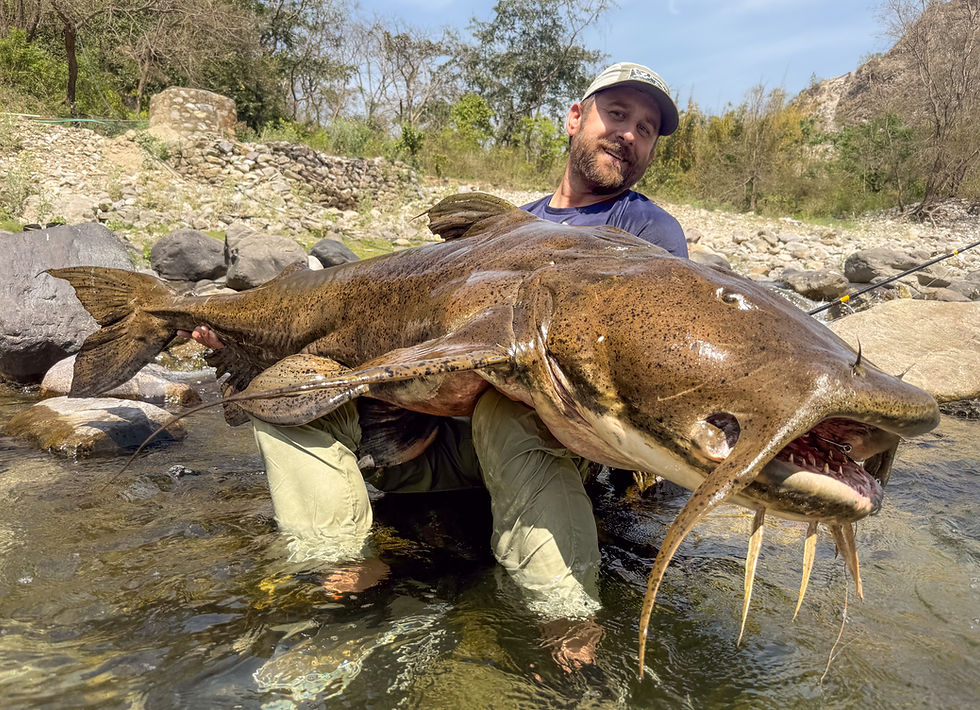
The goonch measured 6 feet 1 inch in length, with a 36-inch girth. I stood there, taking it in - the sheer size of it, the prehistoric mass of its head, the weight of everything it had taken to reach that moment. This fish marked my seventh freshwater species over 100 pounds. I’ve never chased a number, but the idea of reaching ten has lingered in the back of my mind - and I had doubted a goonch would be one of them.
It’s very possible this was the largest goonch taken from this region in the last decade.


That night, rather than subjecting ourselves to one final, sleep-deprived stretch on the rocks, Jacob and I allowed ourselves the luxury of real rest. By morning, we would begin the long journey back to Delhi.
But the jungle wasn’t finished with us...
A Spotted Farewell
In the early hours of our final morning in India, I woke to the sharp, desperate cries of an animal in distress just outside my tent. I scrambled for my glasses and stepped outside in time to see it - a mortally wounded deer tumbling down the hillside, no more than forty yards from my tent.
I saw our guides running and pointing toward the brush above. There, just beyond the fallen deer, silently cutting through the shrubs, was a large male leopard. Its spotted coat slipped in and out of view as it climbed the hillside. Then, for a brief moment, it stopped - turned - and looked directly at me... And then it was gone.
That fleeting glimpse felt like something more than chance. It was a closing note - a reminder. In those same forests where Jim Corbett once walked in pursuit of man-eaters, the predator still moves as it always has... unseen - absolute.
I had come here chasing a different kind of monster. Over rock and river, through jungle and uncertainty, we followed its trail. In the waters of the Ramganga, I found it - the river’s own apex predator, as elusive and formidable in its world as the tiger in the forest.
The mighty goonch.
And in the end, it felt as though the jungle had allowed it - on its own terms.


great read, reminds me of Jeremy Wade's episode hunting one of these beasts
This is an awesome read! I can't wait to start my international angling adventures; I have a few more local targets first before I deem myself worthy of such a journey.
You are a legend bro
Incredible